
Image


Since taking the reins at Stellantis in May 2025, Neapolitan engineer Antonio Filosa has been travelling the globe, speaking his mind: either we give customers back their freedom of choice, or we hand over the keys to China! At issue is the unilateral European regulation that has stalled the market. It is a view widely shared by François Provost, CEO of Renault.
Just before Brussels loosened the stranglehold of standards and the 2035 deadline with its Automotive Package, the two executives spoke out publicly in a manner that was corrosive enough to be explicit. For Antonio Filosa, the conclusion is clear: while China is sprinting ahead with its batteries and speed of execution, North America is stabilising its growth, and South America and the Middle East and Africa are poised to be the next Eldorado (GDP and demographic growth), Europe is stalling with 3 million too few cars on the market! “The European market is not keeping pace with regulation,” he insisted (at the Plateforme Automobile, November 2025). Brussels is imposing a pace that customers refuse to follow for three reasons: they don't want it, they don't need it, and they can't even afford it!
Faced with the advance of the Chinese ecosystem, there is no blind protectionism, no plan B, but agility. His vision is clear: Europe must regain control of its industrial destiny. Stellantis has therefore invested €2 billion in France this year, in addition to the $13 billion planned in the United States over four years. At the head of ACEA*, he has succeeded in creating a wide consensus. Trade unions, suppliers, manufacturers: everyone is aligned behind his plan A. The goal? A strategic dialogue with decision-makers to turn the tide by offering cars that people want, need and can afford.
Finally, Antonio Filosa makes no secret of his annoyance at the regulations governing light commercial vehicles. “They are very, very, very bad,” he repeated. Forcing a tradesman to swap his indestructible diesel for an overpriced and less versatile electric vehicle is an economic aberration. The CEO calls for a focus on affordable small electric cars and respect for technological neutrality, suggests ‘super loans’ for small models and advocates an active fleet renewal policy, since of the 250 million cars on the road, more than 150 million are over 12 years old. “That's what we should be focussing on!”
*ACEA: European Automobile Manufacturers’ Association.
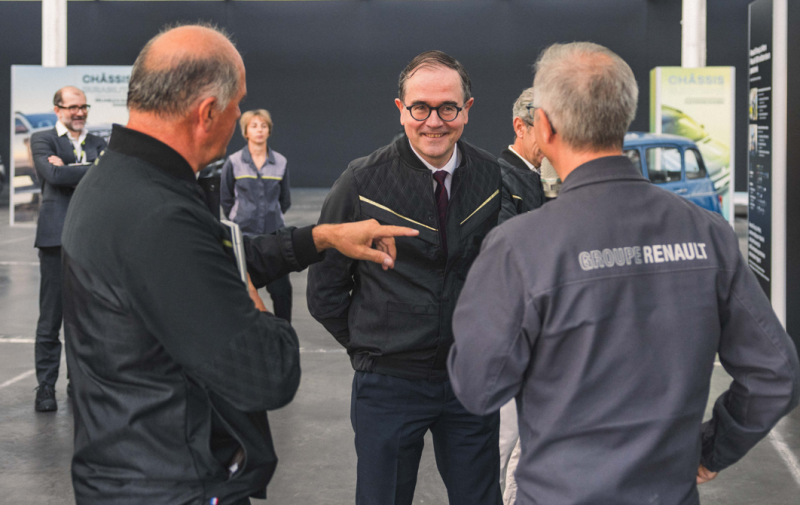
For his part, François Provost warns that without immediate flexibility, Europe is organising its own decline. The Renault boss has made a surgical diagnosis of a European industry in free fall. At the Guyancourt Technocentre, 25% of engineers' time is now taken up by compliance management alone! Not to invent the engine of tomorrow or reduce costs, but to digest a legislative inflation of 107 new regulations by 2030. The result? A forced ‘premiumisation’ that is driving the middle classes out of showrooms. The compact car, the historic lifeblood of French industry, has become a luxury for the over-60s. Meanwhile, China produces 30% of the world's fleet and develops a model in two years, whereas the Old Continent still takes four! It is no longer just the world's factory, it is its own laboratory. Renault has set up its own R&D centre there: ‘learn and understand’ in order to replicate this agility in Europe.
In Europe, one in two households fears the planned obsolescence of their vehicle, whether it is combustion engine powered or electric. François Provost is betting everything on the new Twingo. Developed in less than two years – a feat in itself –, it aims to retail at under €20,000 while remaining produced in Europe. To achieve this, the rules for small cars (category M1E) must be frozen for 10 to 15 years to stabilise costs. Next, if electric is the future for urban areas, a five-year flexibility period is vital for hybrids and commercial vehicles. Finally, mandatory ‘local content’ must be imposed on all manufacturers selling in the EU, copying the Chinese strategy of twenty years ago. “If we don't change our approach, we will be scientifically organising the decline of our industry,” he concluded.


